The subtitling-versus-dubbing question isn't a format preference decided in post-production — it's a strategic call that belongs in the creative brief, next to decisions about casting and media mix. The right answer changes by audience segment, platform, and even by spot within the same campaign. Treating it as an afterthought, or worse, a line-item cut, routinely produces work that technically reaches a multicultural audience while failing to actually speak to it.
A client asks for the Spanish-language version of a campaign and a producer quietly makes the call: subtitles, because they're faster and cheaper, or dubbing, because that's what the last project did. Neither reason has anything to do with the audience. And that's the pattern worth naming — subtitling and dubbing get treated as interchangeable technical outputs instead of two fundamentally different ways of relating to a viewer, each with its own strengths, failure modes, and audience chemistry.
This isn't a debate about which format is objectively better — it's a debate agencies and brands keep skipping because the decision gets made by whoever is cheapest or fastest that week, not by who the work is actually for. Platform, market, generation, and content type all push toward different answers, and a multicultural production built on real audience insight treats that choice with the same rigor as casting or media selection, not as a budget line resolved after the creative is locked.
The Variables That Actually Decide the Format
Audience comfort with reading pace is the first and most underestimated variable. Dubbing tends to perform better with viewers less comfortable processing fast on-screen text — a meaningful share of older viewers and recent arrivals across Latin American markets, where dubbed content has long been the broadcast norm. Subtitling, by contrast, tends to land harder with audiences fluent in both languages who already toggle between them constantly: younger, U.S.-raised Hispanic viewers who code-switch daily and, per industry analysis from localization specialists like TransPerfect, often read subtitles as a signal of authenticity rather than a barrier to understanding.
Platform and content format push just as hard in their own direction. Broadcast and connected TV still favor dubbing because the viewing posture is passive — a living room audience isn't leaning in to read. Social and short-form video skew the other way: sound-off mobile viewing makes burned-in captions close to mandatory regardless of language, giving subtitling a practical edge where most video plays muted by default. Add budget and timeline — dubbing needs casting, direction, a studio session, and a mix; subtitling needs translation, timing, and QC — and the two formats aren't just creatively different, they're operationally different projects.
- Audience reading comfort and generational fluency shape comprehension and credibility more than translation quality does.
- Platform viewing posture — passive broadcast vs. sound-off mobile — often decides the format before creative even starts.
- Dubbing timelines run longer and cost more: casting, direction, studio time, and mix add weeks subtitling doesn't need.
- Subtitling preserves the original performance: the real voice, pacing, and emotional texture of the actor or spokesperson.
- Market norms matter: broadcast-first Latin American markets expect dubbing; acculturated U.S. Hispanic segments often read subtitles as more credible.
Why Dubbing Still Wins Broadcast — and Can Still Go Wrong
Dubbing earns its place for real reasons, not just habit. It removes all reading burden, which matters enormously for broadcast and CTV environments where attention is split across a room, a second screen, or a toddler. It also matches viewing conventions that run deep in markets like much of Mexico, Central America, and large parts of South America, where dubbed U.S. content has been the default for decades — making subtitles feel foreign in exactly the markets where dubbing feels native.
The risk is what the industry calls flattening — a dubbed performance that loses the rhythm, humor, or emotional edge of the original because the session was treated as a technical pass-through instead of a real performance. Done well, with talent matched to the audience's register and regional accent, dubbing feels entirely native. Done as a rush job, it flattens a sharp brand voice into something generic — a risk AI-assisted pre-production tools, like Kaiman Studio's dubbing workflows, help reduce by speeding up script adaptation and scratch tracks, without replacing the casting and direction judgment that actually prevents flattening.
“Dubbing replaces a voice. Subtitling preserves one. The brands that get this right ask which their audience actually wants before they ask what it costs.”
Why Subtitling Is Winning the Acculturated U.S. Hispanic Audience
The fastest-growing argument for subtitling has nothing to do with cost and everything to do with identity. Bilingual, U.S.-raised Hispanic audiences — the segment driving most U.S. Hispanic market growth — live in both languages simultaneously, and work that dubs over an actor's real voice can read as talking down to an audience that doesn't need the translation handled for them. Subtitles let that audience hear the original performance, including the accent, the slang, the specific cadence of a real person, while still making the meaning accessible to a monolingual household member in the room.
That preference compounds on the platforms where this audience spends the most time. Social-first, bilingual, and highly online, younger U.S. Hispanic viewers are already fluent in muted, captioned video — it's how most of their feed autoplays — so subtitling isn't a compromise on these platforms, it's the native format. Pair that with the credibility signal subtitles carry — unaltered original audio reads as more authentic, more documentary, less manufactured — and the format becomes a brand-voice decision as much as a technical one, which is exactly why it belongs in strategy conversations, not just production ones.
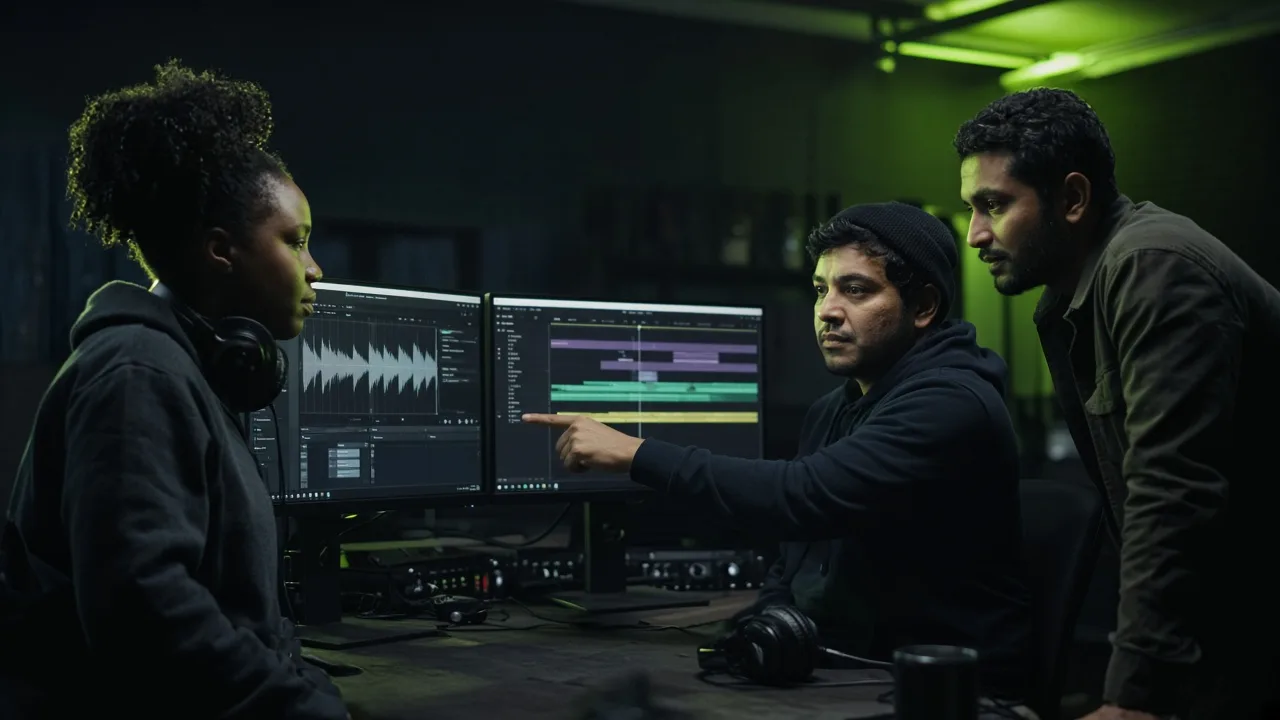
Subtitling and dubbing decisions get made here — in the edit suite, where audience, platform, and performance all have to agree.
Should Spanish-language ads use subtitles or dubbing?
It depends on the audience and platform, not a fixed rule. Bilingual, U.S.-raised Hispanic viewers and most social or mobile placements tend to respond better to subtitles, while broadcast, CTV, and audiences in dubbing-first Latin American markets typically respond better to dubbed audio. The right call starts with who's watching and where, not with which format is cheaper.
Is dubbing more expensive than subtitling?
Generally yes, and by a meaningful margin. Dubbing requires casting voice talent, direction, a recording session, and an audio mix, while subtitling requires translation, timing, and quality control — fewer production stages and a shorter timeline. That cost gap is real, but it shouldn't be the deciding factor on its own; audience and platform fit matter more than the line item.
Why do subtitles sometimes feel more authentic than dubbing?
Because subtitles preserve the original performance — the actual voice, accent, and emotional delivery of the person on screen — while dubbing replaces it entirely. For audiences who associate an unaltered voice with credibility, especially bilingual viewers who don't need the translation handled for them, subtitles can read as more honest and less manufactured than a dubbed track.
Localization isn't a post-production checkbox.