Brands are increasingly pairing a lead general-market agency with dedicated multicultural and production specialists rather than asking one shop to do it all. The shift is driven by margin pressure inside holding companies, the rise of AI-accelerated production, and a hard truth: cultural fluency doesn't scale as a line item inside a generalist roster.
For two decades, the agency-of-record contract was the anchor of how brands organized their marketing. One shop, one retainer, one point of accountability for strategy, creative, media, and increasingly, everything downstream of it. That model made sense when audiences behaved like one audience. It makes far less sense in 2026, when the fastest-growing consumer segments in the United States — Hispanic, Black, Asian American, and multigenerational multicultural households — do not respond to work built for a "general market" that no longer exists as a monolith. What's changing isn't that brands want more vendors to manage. It's that the economics and the output quality of the old model are both under real pressure at once. eMarketer's Ad Agency Trends 2026 report points to a widening gap between overall ad spending growth and agency holding company performance — a sign that the traditional AOR structure is absorbing cost without always delivering proportional value. At the same time, brands serving Walt Disney, Molson Coors, and public-sector clients like the United Nations have learned that culturally specific work requires culturally specific teams, not a single shop stretched across every audience it claims to understand.
Why the Single-AOR Model Is Straining
The pressure on the traditional AOR model isn't coming from one direction — it's coming from three at once. AI is compressing production timelines and costs, forcing agencies to rethink what they charge for. Staffing has gotten harder, with WE Interactive's 2026 agency industry analysis finding that 70% of agency professionals say their roles are harder than two years ago, and 54% report rising client tension over the same period. Add margin compression at the holding-company level, and the incentive to keep every discipline under one contract starts to break down. Multicultural work is where that strain shows up fastest, because it's often treated as an add-on inside a generalist retainer rather than a core practice. A single AOR optimized for reach across a broad audience rarely has the bench — casting relationships, native-language creative teams, production networks across Bogotá, Miami, and México D.F. — to do culturally specific work at the level clients like Universal Orlando, AARP, or Gala Foods need. Notably, some 2026 industry analysis argues the opposite is happening in general-market services, with brands consolidating vendors to avoid fragmented brand stories. That logic holds for commodity services. It breaks down for cultural expertise, which doesn't compress into a shared retainer without losing what made it valuable.
- General-market AORs are increasingly built for efficiency and reach, not for the cultural nuance that credible multicultural work requires.
- AI-accelerated production is changing what brands expect to pay for, pushing agencies to specialize rather than generalize.
- Rising client-agency tension and harder-than-ever agency roles are symptoms of a model stretched past its original design.
- Holding-company revenue pressure is forcing agencies to defend every retainer line item, multicultural included.
- Specialist rosters let brands pair broad-reach efficiency with deep-market authenticity instead of choosing one over the other.
What a Specialist Roster Actually Looks Like
A specialist roster isn't a rejection of the AOR concept — it's a more honest version of it. A brand keeps a lead partner for enterprise strategy and media scale, and adds a multicultural and production specialist for the work that needs cultural credibility to land: campaigns built in Spanish or bilingually from the brief forward, casting that reflects the audience rather than approximating it, and production that understands regional nuance across markets from Miami to Bogotá to London. The specialist isn't a subcontractor translating someone else's idea after the fact. It's a partner in the room from strategy through final cut. This is the model Alerta! Creative Agency was built around. As a full-service, multicultural integrated creative and production agency with offices across Miami, New York, Bogotá, London, and México D.F., Alerta operates as the specialist layer brands add alongside their existing agency relationships — bringing culturally fluent strategy, creative, and in-house production to categories from CPG and healthcare to public sector and entertainment. That structure is also why NMSDC certified Alerta as a minority business enterprise in 2024: the specialization is real, not a repackaged general-market offering with a Spanish-language layer added on top.
“Cultural fluency isn't a service line you bolt onto a generalist retainer — it's a discipline that has to live in the room from day one.”
How Brands Should Evaluate the Shift
Brands weighing this shift should start by auditing where cultural nuance actually lives in their current AOR relationship — is it a dedicated team with native-market production capability, or a single strategist covering "diversity" across every audience the agency serves? The honest answer for most brands is the latter, and it's rarely a reflection of agency talent so much as structural reality: one shop can't credibly own every cultural context at the depth today's consumers expect. The brands getting this right in 2026 aren't abandoning their lead agencies — they're building a roster where each partner does what it's actually built to do. That means a lead AOR for scale and infrastructure, and a specialist partner for the markets, languages, and communities where authenticity is the entire point. Getting that structure right early avoids the more expensive fix later: a campaign that reads as translated rather than created, in a year when audiences notice the difference immediately.
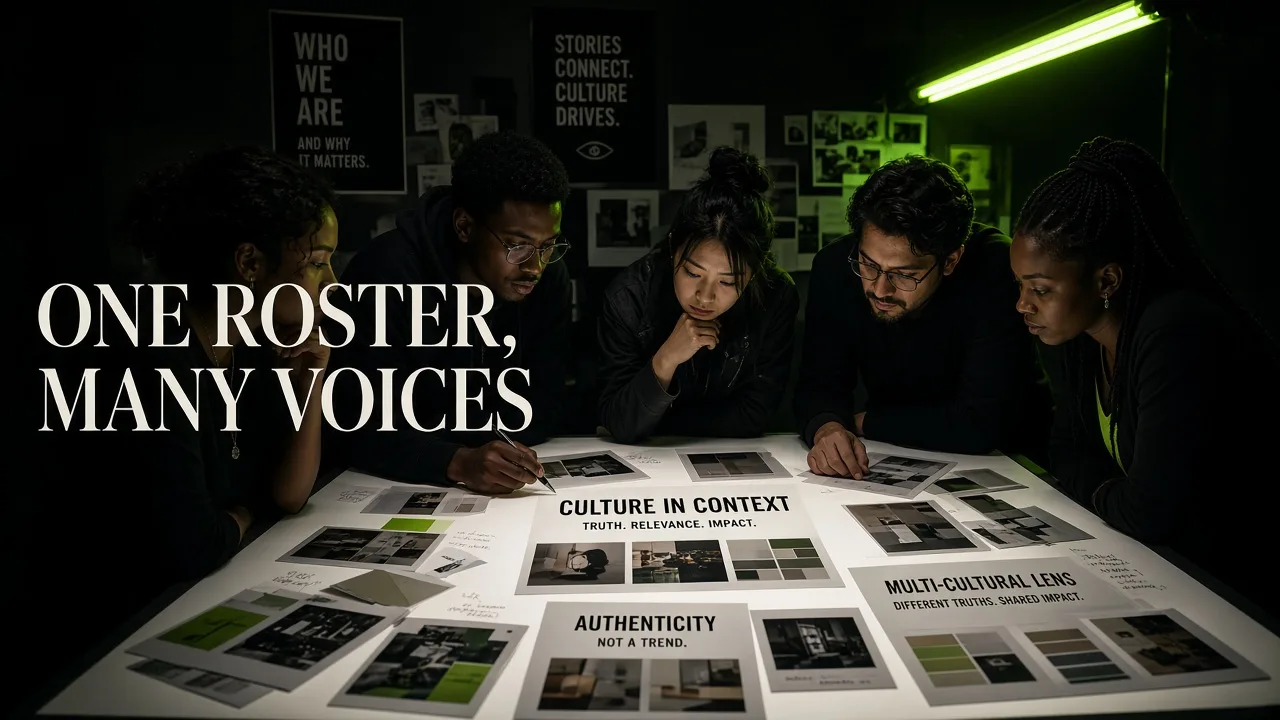
Specialist rosters put cultural expertise in the room from day one — not layered on after the strategy is set.
What does "splitting the agency of record" mean in 2026?
It means brands are pairing their lead general-market agency with a dedicated multicultural or specialist production partner instead of asking one shop to handle every audience and discipline under a single retainer.
Why is multicultural work specifically driving this shift?
Multicultural audiences respond to culturally specific creative, casting, and production, and most general-market AORs aren't structured to deliver that depth alongside their broader-reach mandate — so brands add a specialist rather than stretch the generalist further.
Does adding a multicultural specialist agency replace the lead AOR?
No — it typically complements it. The lead agency continues to own broad strategy and media scale, while the specialist partner owns the cultural fluency, native-language creative, and regional production that make multicultural campaigns credible.
Your audience isn't one audience — your agency roster shouldn't be either.