AI dubbing has become a legitimate production tool, cutting cost and turnaround dramatically compared to traditional studio work. It still falls short on emotional authenticity, cultural adaptation, and the lip-sync precision that premium bilingual production demands — which is why human casting, direction, and native-speaker review remain essential rather than optional.
The AI dubbing pitch is compelling on paper: a video's original audio, replaced by a translated, AI-generated voice that preserves the original speaker's tone and vocal characteristics, delivered in hours instead of weeks. The market is scaling to match the hype — AI dubbing is projected to grow from roughly $31.5 million in 2024 to $397 million by 2032, a 44.4% compound annual growth rate that reflects real, justified demand for faster, cheaper localization. What the pitch leaves out is what still requires a human in the room. AI dubbing has genuinely matured — modern systems handle diarization, preserve rough emotional tone, and manage multi-speaker content with far better lip-sync accuracy than early versions of the technology. But "far better" isn't the same as "solved." For brands producing bilingual content that has to land with real cultural weight — a campaign for Walt Disney, a public health message for the United Nations, a Butterball holiday spot — the gap between AI-adequate and audience-ready is exactly where human casting and creative direction still earn their keep.
Where the Technology Genuinely Delivers
It's worth being direct about what AI dubbing does well, because the gains are real. Cost has dropped dramatically — AI dubbing runs roughly $2 to $30 per minute compared to $50 to $200 per minute for traditional studio dubbing, and turnaround has compressed from weeks to hours for straightforward content. The six-stage pipeline — transcription, translation, text-to-speech synthesis, voice cloning, lip sync, and emotional delivery modeling — has gotten measurably better at each stage, particularly for corporate training content, product explainers, and lower-stakes internal communications where speed matters more than nuance. That makes AI dubbing a legitimate tool for a real category of bilingual production work. It's a poor fit, though, for content where the performance itself is the point — narrative work, brand films, anything where an audience needs to feel a moment rather than just understand it. The technology is a production accelerant for volume content and a starting point, at best, for anything creative.
- AI dubbing cuts cost by roughly 80-90% compared to traditional studio dubbing for straightforward content.
- Turnaround compresses from weeks to hours, making it viable for high-volume or time-sensitive localization.
- Diarization and multi-speaker handling have improved significantly, reducing manual cleanup work.
- The technology performs best on corporate, training, and explainer content — not narrative or brand storytelling.
- Native-speaker review remains a required step before publication, regardless of how advanced the underlying model is.
Where Human Judgment Still Wins
The clearest gap is emotional authenticity. AI-generated voices can now replicate tone and pacing with real sophistication, but they still tend to miss the specific, subtle cues — a slight crack in the voice, a beat of hesitation — that signal sincerity to an audience. Lip-sync timing mismatches, especially between languages with different phonetic rhythms, can create a low-grade "uncanny valley" effect where viewers sense something is off without being able to name it. And cultural adaptation — idioms, humor, region-specific references — still requires human contextual judgment that translation models don't reliably supply on their own. This is precisely where casting and direction matter most in bilingual production. Choosing the right voice talent for a market isn't just a technical match of pitch and pacing — it's a creative decision about how a brand should sound in that culture, delivered by someone who understands the difference between correct Spanish and Spanish that actually resonates in Miami, Bogotá, or México D.F. That judgment is what keeps bilingual production from reading as dubbed rather than made.
“AI can clone a voice. It still can't decide how a brand should sound.”
The Right Way to Use AI in Bilingual Production
The smartest production approach in 2026 isn't choosing between AI dubbing and human production — it's knowing which tasks belong to which. AI dubbing is a strong fit for high-volume, lower-stakes localization where speed and cost matter more than performance nuance. Human casting, direction, and native-speaker review remain non-negotiable for any content where the creative execution is the actual brand message — hero campaigns, narrative spots, anything designed to move an audience rather than simply inform one. Governance matters here too: voice cloning requires explicit informed consent from talent, and data protection and deepfake-prevention compliance are real considerations, not afterthoughts, as the technology scales. Production partners who understand both the creative and the compliance side of AI dubbing are the ones brands should be building bilingual work with going forward — using the technology where it earns its place, and keeping human judgment where the performance is the product.
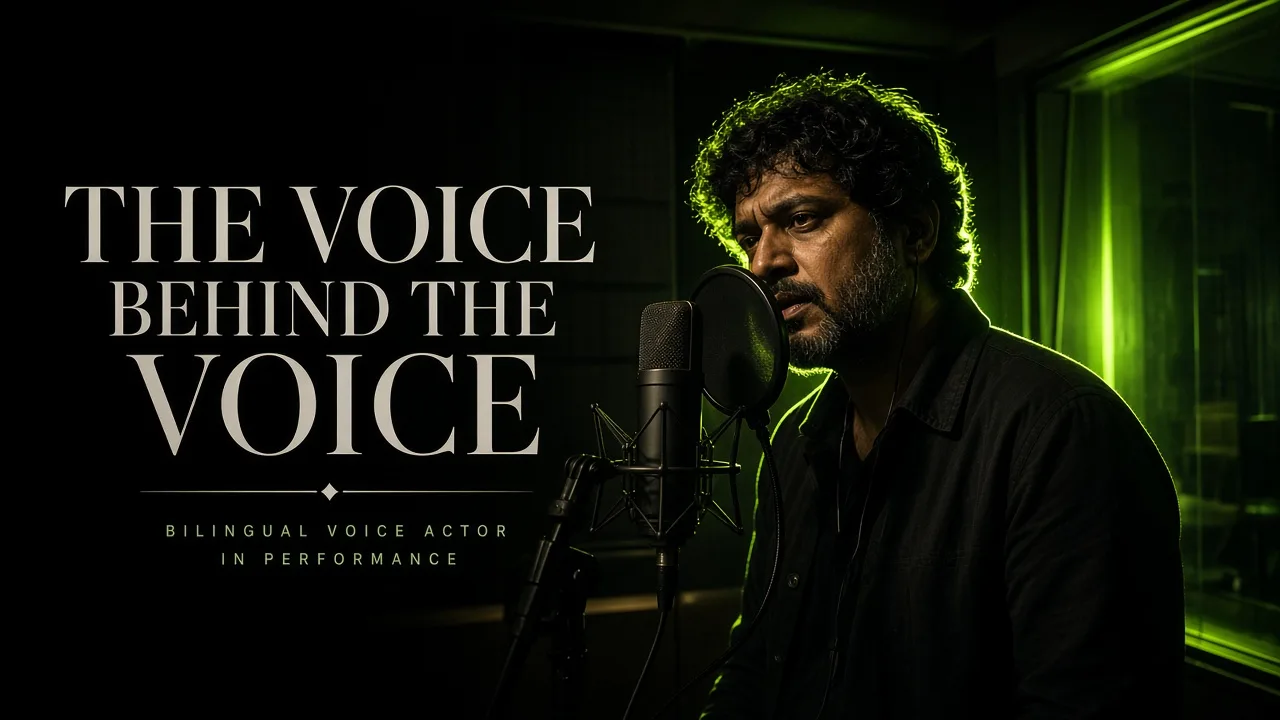
The technology can clone a voice — casting and direction are still what make it believable.
Is AI dubbing good enough to replace human voice talent in 2026?
For high-volume, lower-stakes content like training videos and explainers, AI dubbing is often good enough. For narrative, brand, or emotionally driven content, human casting and direction still outperform AI on authenticity and cultural nuance.
What is the biggest limitation of AI dubbing right now?
Emotional authenticity and cultural adaptation remain the biggest gaps — AI systems can replicate tone and pacing but still struggle with the subtle cues that signal sincerity and with idioms or references that require genuine cultural context.
How much cheaper is AI dubbing than traditional studio dubbing?
AI dubbing typically costs between $2 and $30 per minute, compared to $50 to $200 per minute for traditional studio dubbing, with turnaround measured in hours rather than weeks.
The tools got faster. The craft still has to be earned.